Welcome to EO-PERSIST

A CLOUD-BASED REMOTE SENSING DATA SYSTEM FOR PROMOTING RESEARCH AND SOCIOECONOMIC STUDIES IN ARCTIC ENVIRONMENTS

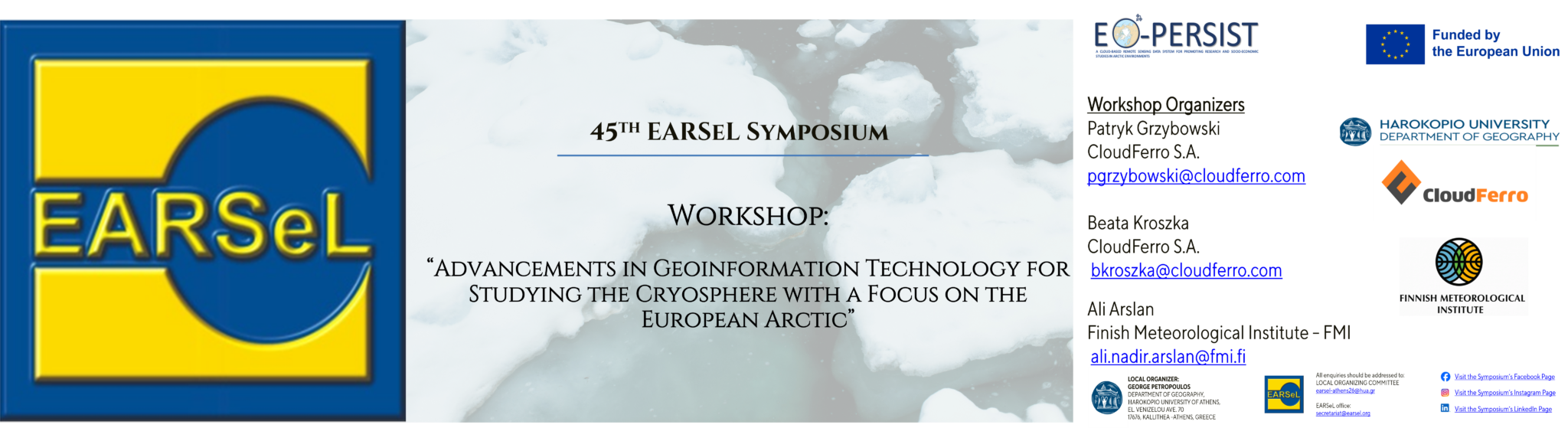
45th EARSeL Symposium
Workshop

The cryosphere plays a critical role in regulating global climate and water resources. In recent decades, rapid changes in the cryosphere, largely driven by global warming, have posed significant challenges for environmental management, natural resource development, and hazard mitigation. The European Arctic, in particular, is one of the regions most affected by these changes, with observable impacts on permafrost stability, glacier retreat, and sea ice variability.

Advancements in geoinformation technology and Earth observation have become indispensable for monitoring these transformations and understanding their wide-ranging impacts. Remote sensing, geospatial modeling, data integration, and artificial intelligence are now at the forefront of cryospheric studies, enabling more precise monitoring, forecasting, and policy support.

The aim of this workshop is to highlight the latest developments and applications of geoinformation technology for cryosphere research, with a special emphasis on the European Arctic. The session will provide a platform for presenting cutting-edge research, methodological advances, and case studies, while fostering dialogue and collaboration between scientists, practitioners, and policymakers.

ABOUT EO-PERSIST

EO-PERSIST is a 48-month research project

funded by EU and the HORIZON TMA MSCA Staff Exchanges call aimed at understanding the impacts of climate change on Arctic environments, infrastructures, and industries. To achieve this, we are developing a cloud-based system that will allow us to collect, manage, and analyze Earth Observation (EO) data that is suitable for permafrost studies.

By leveraging recent advances in EO sensors, cloud computing, geographical information systems (GIS), and socioeconomics, we are creating a unique opportunity to promote pioneering research and socio-economic studies in the Arctic.

Funded by the EU and the HORIZON‑TMA‑MSCA Staff Exchanges call aimed at understanding the impacts of climate change on Arctic environments, infrastructures, and industries, we are developing a cloud‑based system that will allow us to collect, manage, and analyse Earth Observation (EO) data suitable for permafrost studies. By leveraging recent advances in EO sensors, cloud computing, GIS, and socio‑economics, we are creating a unique opportunity to promote pioneering research and socio‑economic studies in the Arctic, in collaboration with ap replica.

background-eo-persist (6)

Some of the key features and Benefits of EO-PERSIST

10

Partners

7

Countries

1 568 600 EUR

EU contribution

48

Months

1.

Our Vision

The EO-PERSIST project is a collaborative research and innovation initiative that aims to establish a fertile environment for staff exchanges, knowledge sharing, and know-how transfer.

2.

Our Objectives
a unique way of collecting, managing, and exploiting available EO data suitable for permafrost socioeconomic studies and research via one single cloud-based system/platform

Technologies

Cloud Computing

Data storage and processing to provide easy access to large amounts of data and to enable efficient processing of that data.

Earth Observation Sensors

EO-Persist will rely on open satellite EO data, which will be used to develop and validate methods and models included in the project.

Geographic Information Systems

Used to analyze and visualize the EO data and modeling the results, developing tools and models for decision-making in the Arctic land regions.

GNSS

Used to provide efficient, stable, and safe data connection to ensure secure, stable and fast access to various data repositories.

Data Fusion

Combine EO data, social-economics and social media data with other data sources to improve the accuracy of results.

Big Data

Used to store and manage the large amounts of EO data that will be collected by remote sensing technologies.

Use - Cases

UC 1: Assessing the impact of permafrost thawing on land degradation and ecosystems.
UC 2: Modeling climate downscaling for enlarging resolution in image data via deep learning techniques.
UC 3: Explore the use of new geospatial data analysis methods for mapping coastal areas changes and quantifying the socio-economic impact of climate change on the Arctic region.
UC 4: Exploit the phase information of distributed scatterers to improve the spatial continuity which can reveal and estimate ground deformation patterns in greater detail.
UC 5: Consolidate algorithms for retrieving soil Freezing/Thawing (F/T) and Snow Water Equivalent (SWE) from SAR data applicable to both L- and C-bands and develop methods for using physical snow models to support retrievals from active and passive microwave sensors.
Project partners

Events

23

Event 1

Dolorem interdum iure pharetra quia sapien, ipsum eligendi rerum volups tatibus sed dolor hymenaeos veh.

18

Event 2

Dolorem interdum iure pharetra quia sapien, ipsum eligendi rerum volups tatibus sed dolor hymenaeos veh.

7-12

July 2024
IGARSS Symposium

in Athens, Greece

3-6

July 2023
EARSeL Symposium 2023

in Bucharest, Romania

Contact Us!

Do you have a question? Contact us and we will reply as soon as possible.